Is there a serving size?
The first line of the panel. Without it nothing else has a unit. This product prints one — 1 capsule, 60 servings — and the wrap agrees with it.
An ingredient name tells you what somebody chose. Only a number tells you whether it can do anything, and a blend gives you a ceiling instead of a number.
Written by the BloodPril editorial team·Last updated October 12, 2026·How this page was checked
To check a supplement against its evidence you need four things: the serving size, the amount of each ingredient per serving, the standardisation or salt fraction, and the dose the research actually used. On this product the first is printed and the fourth is published in two meta-analyses, but the middle two are not available, because the three ingredients sit inside a 500 mg proprietary blend. So the method changes shape rather than stopping. A blend discloses a total and an order of predominance, and from those you derive a ceiling for every line: at most 500 mg of L-Citrulline dl-Malate, at most 250 mg of the first arginine and at most 167 mg of the second. Then set those against the trials. The citrulline analysis used 3 to 9 g a day, so a 500 mg ceiling is at best a sixth of its lowest dose. The arginine analysis used 4 to 24 g a day, so 250 mg is about a sixteenth and 167 mg about a twenty-fourth. Every comparison there is generous, because a ceiling is not an amount and all three ingredients are salts.
Every ingredient in this aisle has a literature behind it, and every one of those literatures is written in doses.
That is not a technicality. It is the difference between a finding and a gesture. A trial reports its effect at a dose, for a duration, in a population, and the dose is not a detail of the study — it is the intervention.
So a pack that names a studied ingredient has stopped one step short. The honest question is never is this ingredient studied? It is is this amount of it studied? Both amino acids here have real pooled human evidence for blood pressure, which makes the amount question sharper rather than softer.
And a ceiling is not an amount. This panel prints one weight — Proprietary Blend 500 mg — over three names in a fixed order, so every figure on this page is the most an ingredient can be rather than what it is.
All four, or the comparison does not work. Most labels give you two or three. This one gives you two and a half.
| What you need | Where it comes from | What happens without it |
|---|---|---|
| Serving size | The first line of the Supplement Facts panel | Every other number loses its unit. This product prints it — 1 capsule, 60 servings — and the suggested use agrees with it |
| Amount per serving | The ingredient's own line on the panel | Nothing can be compared directly. Inside a blend the order of predominance still gives a ceiling. Here: a 500 mg total, and 0 of 3 individual weights |
| Standardisation, or the salt fraction | A percentage beside an extract, or the free-amino-acid content of a salt | A weight of salt cannot be turned into a weight of the amino acid the trials used. Not published — and all three lines are salts |
| The studied dose | The paper or public-health source you compare with | You are comparing against nothing. Available here — two meta-analyses, at 3–9 g and 4–24 g a day |
Two of the four are in hand and the hard one is bounded rather than blank. That is the difference between a blend and a pack with no panel at all.
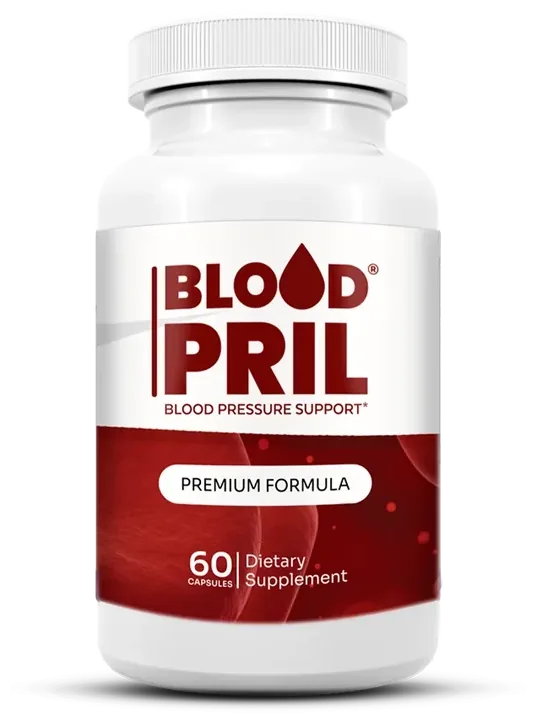
BloodPril is a 60-capsule bottle, taken as one capsule daily with an 8 oz glass of water, up to two. The Supplement Facts panel is complete, and it declares one dietary line: a 500 mg proprietary blend of three ingredients, two of them the same amino acid in different salts. No individual amount is printed. What can be checked is the arithmetic: 60 capsules at one a day is 60 days a bottle, 30 at two.
60-day money-back window · from $0.82 a day · 60 days a bottle · ships from the USOne. Read the serving size, and check it against the suggested use. A panel written per two capsules and an instruction to take one describe different doses. Here they agree: Serving Size: 1 capsule, and take one (1) capsule daily. Note the next sentence though — May take up to two (2) capsules daily — because it doubles every figure below it.
Two. Find your ingredient's line and take the number. If it has one, you are nearly finished. If it sits inside a proprietary blend, take the total, count the position in the descending list and divide: position one can be the whole total, position two at most half, position three at most a third. That gives a ceiling, never a floor.
Three. Convert it, if it is an extract or a salt. On an extract that means a stated percentage of a named marker compound. On an amino acid it means the salt fraction, and none is published here: dl-malate is part malic acid, alpha-ketoglutarate dihydrate is part ketoglutarate and water, HCL is roughly 17 per cent hydrochloric acid by weight.
Four. Set the two numbers side by side, with their units, in a column, before you form any opinion. Put them in the same unit first. 500 mg is 0.5 g; 3 g is 3,000 mg. Almost every disappointment in this aisle becomes visible at this step.
Five. Say what you found out loud. Here it sounds like this: the trials used three to nine grams a day and the whole blend is half a gram, shared between three lines, two of which are the same amino acid. Say that out loud and you do not need a verdict from anybody.
Always write the two numbers with their units, next to each other, before you form an opinion. Milligrams and grams differ by a thousand: invisible in prose, obvious in a column. Where one number is a ceiling rather than an amount, write the word ceiling beside it and keep writing it every time you use the figure.
This is the case most guides skip, and it is the case here. The panel declares one dietary line: Proprietary Blend 500 mg †, with three ingredients beneath it and no individual weight. Under 21 CFR 101.36(c) that is permitted: a blend declares its total and lists its contents in descending order of predominance by weight.
Line one: L-Citrulline dl-Malate, ceiling 500 mg. Nothing is listed above it, so it could in principle be the whole blend. The analysis we opened covers eight trials and records that “dosage of L-citrulline supplementation varied from 3 to 9 g/day”. Three grams is 3,000 mg. Even if this blend were nothing but citrulline, that is a sixth of the lowest dose in it — and it is not, because two arginine lines share the same 500 mg.
Line two: L-Arginine (Alpha-Ketoglutarate dihydrate), ceiling 250 mg. It cannot exceed the line above it, so at most half the total. The arginine analysis pooled “11 randomized, double-blind, placebo-controlled trials involving 387 participants” at doses “ranging from 4 to 24 g/d”. Four grams is 4,000 mg, so a 250 mg ceiling is about one sixteenth of the lowest dose there.
Line three: L-Arginine HCL, ceiling 167 mg. Third in the order, so at most a third of the total — about one twenty-fourth of the same 4 g floor. And it is the second arginine on the same panel, which makes the ingredient list look longer than the formula is.
Then the two reasons every figure above is generous to the product. The three ceilings cannot all hold at once, because they share one 500 mg: if citrulline were 500 mg, both arginines would be zero. And all three are salts, so part of each weight is malate, ketoglutarate, water or hydrochloride rather than amino acid. The whole blend is 500 mg, or 1 g at the label's maximum, against floors of 3 g and 4 g.
What is still worth doing before you buy. Ask the seller for the three individual amounts, and for the certificate of analysis against lot BP-26/BL-4631 — a reference number is not a certificate, and none was supplied. Ask by email, so the answer is in writing.
Whole-container quantity against the daily serving. It needs only the two figures at the top of this panel: 60 capsules ÷ 1 a day = 60 days, which is exactly the refund window, and 30 days at two. No blend can hide that sum, which is why it is the first one to run on any pack.
A dose comparison is only half the work. The other half is reading the source carefully enough to know which number did what, and the citrulline meta-analysis is the worked example, because it is the one most likely to be quoted at you.
Here is what it found. Systolic: −4.10 mmHg, interval −7.94 to −0.26, p = 0.037 — significant, and only just. Diastolic: −2.08 mmHg, interval −4.32 to 0.16, p = 0.069 — not statistically significant overall, because the interval crosses zero. The diastolic result reached significance only in the subgroup taking 6 g a day or more, at −2.75 mmHg, p = 0.04. So a reader shown the phrase proven to lower blood pressure should be able to ask three questions: which number, at what dose, and significant or not.
Those checks generalise. Which outcome was measured, at what dose, over what duration, and did the interval cross zero. Then be honest in both directions. A dose short of the trials does not prove a product does nothing — it proves the evidence being pointed at does not apply at this amount. A matching dose would prove only that the amount is in the right territory. What the method gives you is a floor: it moves the question from do these amino acids have a literature to does this capsule deliver what that literature tested.
The first line of the panel. Without it nothing else has a unit. This product prints one — 1 capsule, 60 servings — and the wrap agrees with it.
Count them, then count the ones with no figure. That ratio describes a product's disclosure better than anything on the front. Here it is 0 of 3, inside a declared 500 mg total.
Which outcome, at what dose, significant or not. On the citrulline analysis: systolic significant at 3 to 9 g a day, diastolic not significant overall and only at 6 g and above.
It is a general explainer about reading labels and reading sources, not advice about any particular product and not medical advice. No dietary supplement may lawfully claim to diagnose, treat, cure or prevent a disease, and a dose comparison is not a judgement about whether anything is suitable for you. If you take prescription blood-pressure medicine, the thing to tell whoever prescribes it is that the individual amounts here are not published. This site earns a commission on orders placed through it, and no clinician has reviewed these pages.
Not published. Only the 500 mg blend total is printed. Each ingredient can be bounded from the order — at most 500, 250 and 167 mg — and no further. On a product for blood pressure these are the three numbers a reader most needs, and they are the three the label withholds.
From the ordering rule. The first ingredient cannot be more than the whole blend, so its ceiling is 500 mg. The second cannot exceed the first, so it can be at most half the blend: 250 mg. The third at most a third: 167 mg.<p>Every one of those is generous to the product — the real figures are lower, and all three are salts, so part of each weight is malate, ketoglutarate or hydrochloride rather than the amino acid.</p>
We will not guess at a motive. What we can say is what it costs you: you cannot compare this with another product, you cannot set any ingredient against the dose its own trials used except as a ceiling, and you cannot give a clinician a straight answer about how much of anything you are taking.
Yes — the entire dietary portion of the panel is one. 500 mg covering all three ingredients, with no individual weights.
No trial exists on this combination. What can be checked is each ingredient against the dose its own research used, and the answer is the same for all three: the research is in grams and this is in milligrams. Citrulline trials ran at 3–9 g a day, arginine trials at 4–24 g. The whole blend is 0.5 g, and 1 g if you take the two capsules the label permits.
One bottle is 60 capsules, which at one a day is 60 days — exactly the length of the refund window. No single bottle is sold, so the smallest commitment is two bottles: $158, $1.32 a day, and 120 days of a product whose three individual amounts are not printed.
The struck-through figures are $358, $537 and $1,074 — which is $179 multiplied by two, three and six. A crossed-out price is a claim about what something used to sell for, and no date is given on which this product sold at $179 a bottle. We print the struck figures because they are on the offer, and this note beside them because they are arithmetic rather than history. · window runs from purchase · no subscription · not for under 18, pregnancy or nursingWritten and fact-checked by The Bloodprildaily Editorial Desk, last updated October 12, 2026. A highlighted slot means that value has not been supplied yet and nothing has been invented in its place — why the reviewer line is empty.