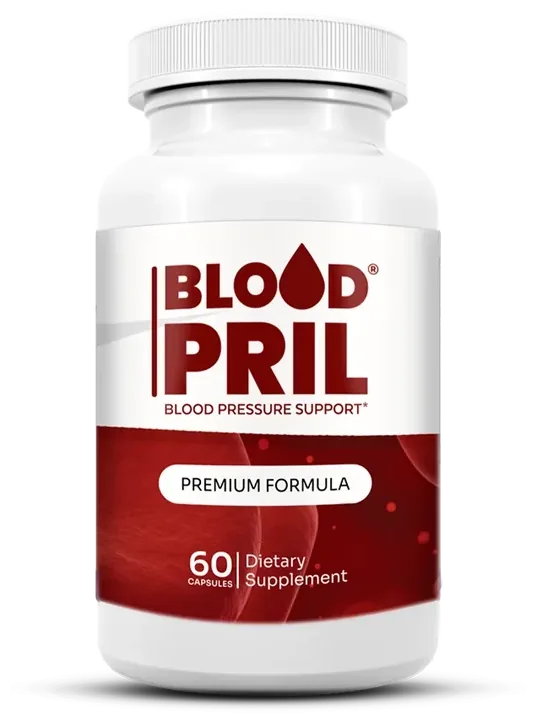
BloodPril Supplement Facts
The panel is real, complete and correctly footnoted. Its dietary half is one line: a 500 mg proprietary blend over three ingredients, with no weight against any of them.
Written by the BloodPril editorial team·Last updated October 12, 2026·How this page was checked
The BloodPril panel is present, complete, and worth reading closely. Serving Size 1 capsule. Servings Per Container 60. Then one dietary line: Proprietary Blend 500 mg, with a dagger in the percent Daily Value column and three ingredients beneath it in order, L-Citrulline dl-Malate, L-Arginine Alpha-Ketoglutarate dihydrate and L-Arginine HCL, with no weight against any of them. The footnote reads Daily Value Not Established, which is correct, because no Daily Value exists for either amino acid. The other-ingredients list is printed in full: Hydroxypropyl Methylcellulose for the capsule, Microcrystalline Cellulose and Magnesium Stearate, which tells a vegetarian buyer the shell is cellulose rather than gelatin. The boxed FDA disclaimer is there, the asterisk on the front claim resolves to it, and the bottle adds that the product has been manufactured in an FDA registered facility, which is accurate wording. So the panel discloses two real things about the blend, a total and an order, and withholds three, the individual weights. Because the three ingredients are listed in descending order of predominance, that order sets ceilings of at most 500, 250 and 167 mg. Every one of those ceilings is generous twice over: the three lines share a single 500 mg, and all three ingredients are salts, so the free amino acid is less again.
The panel, and the wrap it is printed on
Read at native resolution from the artwork supplied with this product. Two faces were supplied rather than one — the Supplement Facts panel on its own, and the full printed wrap it sits on — which is more than most packs this desk reads give a reader.

Two things on this panel are simply correct and worth saying so: the † Daily Value Not Established footnote, because none exists for either amino acid, and the other-ingredients list, which names the capsule shell as hypromellose — cellulose, not gelatin.

This is the most complete label this desk has read. What it does not do is print an amount for any of the three ingredients in the blend.
The panel, exactly as printed
| As printed on the panel | Printed amount | % Daily Value |
|---|---|---|
| Proprietary Blend | 500 mg | † |
| L-Citrulline dl-Malate | not published | † |
| L-Arginine (Alpha-Ketoglutarate dihydrate) | not published | † |
| L-Arginine HCL | not published | † |
The blend total is printed and the three parts are not. Be exact about what that means, because the sentence is easy to soften in either direction. It does not mean the amounts are hidden entirely: a blend discloses a total and an order, and the order is an order of predominance. So the first line can be at most the whole 500 mg, the second at most 250 mg, the third at most 167 mg. Those are ceilings, not amounts, and every one of them is generous to the product. What it does mean is that nobody outside the company knows the three real figures, and that includes this desk.
Two of the three names are the same amino acid in different salts, so a three-ingredient blend is really two active substances sharing one 500 mg total. And all three are salts: dl-malate is part malic acid, alpha-ketoglutarate dihydrate is part ketoglutarate and water, and HCL is roughly 17% hydrochloric acid by weight, so the free amino acid sits below each ceiling again.
The footnote† Daily Value Not Established — correct, because no Daily Value exists for either amino acid in this blend
This is the small thing most labels this desk reads get wrong, and this one gets right. A dagger rather than a percentage is the correct mark when no Daily Value has been set, and none has been set for either amino acid.
Other ingredientsHydroxypropyl Methylcellulose (capsule), Microcrystalline Cellulose, Magnesium Stearate
Three, all ordinary, and the first is useful: hypromellose means the capsule shell is cellulose rather than gelatin, so a vegetarian buyer does not have to guess. That is also the one seal on this product the panel actually supports; non-GMO, gluten free and dairy free are claims about the same short list with no certifying body named anywhere.
The percentages, recomputedThere are none to recompute, and that is correct here. A printed percentage is the one number on a panel a reader can check without leaving the label. This panel prints a dagger instead, because no Daily Value exists for L-citrulline or L-arginine. Nothing on this page has been recomputed, because the panel gives a reader nothing to recheck.
One further detail is worth having beside the blend line. The pooled human trials behind both amino acids used grams. Eight trials of L-citrulline at 3 to 9 g a day; eleven trials of L-arginine across 387 participants at 4 to 24 g a day. The whole blend is 0.5 g, and 1 g at the two capsules the label permits. So on this product the amounts are bounded rather than missing, and every bound falls well short of the doses the research used.
The Daily Value column, rechecked
A printed percentage is the one number on a panel a reader can check without leaving the label, and this desk recomputes every one it finds. This panel prints a dagger instead of a percentage, and the dagger is the correct mark.
| Nutrient | Declared | % DV printed | Daily Value | Our figure | Verdict |
|---|---|---|---|---|---|
| Proprietary Blend, 500 mg | † Daily Value Not Established | correct | † | No Daily Value has been established for L-citrulline or L-arginine, so a dagger is the right mark and the footnote is the right footnote. This line is correct and most labels this desk reads get it wrong. | correct |
| The three ingredients inside it | no amount printed | nothing to recheck | — | A proprietary blend discloses a total and an order, and withholds the individual weights. That is legal. It also means the three figures a reader most needs cannot be checked — only bounded. | blend |
A percentage on a panel is the one number a reader can check without leaving the label, and almost nobody does. We recompute every one we find. On this product there were none to recompute, and that is the correct result: no Daily Value has been established for L-citrulline or L-arginine, so a dagger and the footnote beneath it are exactly right.
Credit where it is dueThis is a small thing and most of the labels this desk reads get it wrong, either by inventing a percentage or by leaving the column blank with no footnote to explain it. This panel does it properly, and the other-ingredients list, the caution statement and the asterisked disclaimer on the same wrap are done properly too.
And what still cannot be checkedThe second row. A proprietary blend discloses a total and an order and withholds the individual weights, which is legal and which leaves a reader with no self-service check at all on the three figures that matter most. What can be done is bounding them: at most 500 mg, 250 mg and 167 mg from the order of predominance. That is not the same as knowing them, and nobody outside the company does.
The panel, read one line at a time
Everything below is ordinary. It is what a reader picking up almost any supplement sold in the United States hopes to find on the back of the pack. The reason it is worth setting out one line at a time here is the opposite of the usual reason. Nearly every one of these lines is present on this bottle. There is one that is not, and it is easier to see once the rest have been read.
Serving Size: 1 capsule. Printed, unambiguous, and in agreement with the suggested use on the other side of the wrap: As a dietary supplement, take one (1) capsule daily with an 8 oz. glass of water. May take up to two (2) capsules daily. A panel and a direction that agree is a smaller thing than it sounds, and a surprising number of packs manage not to do it. What neither line explains is how to choose between one capsule and two, and that choice decides every other figure on this page.
Servings Per Container: 60. Also printed, so a reader is not left dividing. Sixty capsules at the label's own serving is 60 days, which is exactly the 60-day refund window — and 30 days at the two capsules the label permits. The two figures line up so neatly that the pack this desk would have recommended is a single bottle, which is the one pack not sold.
Amount Per Serving: 500 mg. This is a real figure and the panel is entitled to credit for printing it. Proprietary Blend 500 mg † is the whole of the dietary declaration: one row, one weight, one footnote mark. The total is disclosed. What the row does not say is what the 500 mg is made of.
The three ingredients, in order, with no weight against any of them. L-Citrulline dl-Malate, L-Arginine (Alpha-Ketoglutarate dihydrate), L-Arginine HCL. Three names indented under the blend line and not one milligram figure between them. Read the second and third names together: arginine appears twice, as an alpha-ketoglutarate and as a hydrochloride, so a three-ingredient blend is really two active substances presented as three lines.
So be exact about what a proprietary blend is, because the lazy version of this paragraph is wrong in both directions. A blend is not a blank. It discloses two things and withholds three. It discloses a total — 500 mg — and an order, because ingredients inside a blend are listed in descending order of predominance. It withholds the weight of each of the three. That is legal, it is common, and it is also the case that the three figures a buyer most needs here are precisely the three the panel does not print.
The percent Daily Value column, and the dagger in it. The blend line carries †, and the footnote reads † Daily Value Not Established. That is correct. No Daily Value has been set for L-citrulline or for L-arginine, so there is no percentage to print and a dagger is the right mark. A panel that invented a percentage for an ingredient with no Daily Value would be doing something far worse. Most labels this desk reads get this convention wrong. This one gets it right.
Other Ingredients: Hydroxypropyl Methylcellulose (capsule), Microcrystalline Cellulose, Magnesium Stearate. Printed in full, three entries, each named. The first is the most useful line on the panel for a buyer with a rule about what they eat: hypromellose means the shell is cellulose rather than gelatin, so a vegetarian does not have to guess or telephone anybody.
And the box underneath. These statements have not been evaluated by the Food and Drug Administration. This product is not intended to diagnose, treat, cure, or prevent any disease. It is boxed, it is on the same wrap as the claim it answers, and the asterisk on Blood Pressure Support* resolves to it. Beneath that sits This product has been manufactured in an FDA registered facility, which is accurate wording: registration means the facility appears on a list the FDA keeps, not that anything was inspected, endorsed or approved. The label claims the filing and stops, and that restraint is rarer than it should be.
It does not mean the amounts are low. We do not know the amounts, nobody outside the company does, and calling them small would be inventing a figure in the other direction. What it means is narrower and more awkward: the three weights can be bounded but not read. The bounds are in the next section, and they are the only figures this panel permits anybody to compute.
Where 500, 250 and 167 mg come from
This is the arithmetic the rest of this site runs on, so it is worth doing slowly. The panel gives one weight and three names in a fixed order. That order is not decoration. Ingredients inside a proprietary blend are listed in descending order of predominance, which means each name is present in an amount no greater than the name above it. From a total and an order you can derive a ceiling for every line.
First in the order: L-Citrulline dl-Malate. Nothing is listed above it, so nothing bounds it except the total. It could, in principle, be the entire blend. At most 500 mg.
Second: L-Arginine (Alpha-Ketoglutarate dihydrate). It cannot exceed the line in front of it, and together the two cannot exceed 500 mg. The largest the second line can be is therefore half of the total. At most 250 mg.
Third: L-Arginine HCL. It cannot exceed either of the two above it, and all three together cannot exceed 500 mg, so the largest the third line can be is a third of the total. At most 167 mg — 500 divided by three, rounded down.
Now the part that matters most: every one of those three figures is generous twice over. The first reason is the order itself. The three lines share a single 500 mg, so they cannot all sit at their ceilings at once — if citrulline really were the whole 500 mg, both arginine lines would be zero. The second reason is chemistry. All three ingredients are salts, and a salt is part amino acid and part something else. dl-Malate is part malic acid. Alpha-ketoglutarate dihydrate is part ketoglutarate and part water. HCL is roughly 17 per cent hydrochloric acid by weight. So the free amino acid on each line is less than its ceiling again, and nothing printed anywhere says by how much.
Read 500, 250 and 167 mg, then, as the most flattering reading of this label that the label itself permits. They are not amounts and this site never prints them as amounts. They are the roof. What the roof is worth becomes a different question once it is set beside the doses the trials behind these two amino acids actually used, and that comparison is worked through in full on our dose-matching guide.
On most products this is where printed percentages get recomputed against the published Daily Values. Here there is correctly nothing to recompute, so we ran the arithmetic the panel does allow: 500 ÷ 1, 500 ÷ 2 and 500 ÷ 3, from the order of predominance, and 60 capsules ÷ 1 a day = 60 days, which is exactly the refund window. Both sums are on this site with their working.
The printed wrap, annotated
Sixteen markers. Fifteen are things printed on this wrap, and most of them are things this desk is pleased to find. The sixteenth is the one thing that is not on it anywhere.
Swipe the label sideways to reach every marker.
Tap a numbered marker on the label to read what that line says, and what it leaves out.
The other-ingredients list, and the seals that lean on it
The other-ingredients list is printed in full and it is short: Hydroxypropyl Methylcellulose (capsule), Microcrystalline Cellulose, Magnesium Stearate. Three entries, each named, with the function of the first given in brackets. On a capsule product that is the complete declaration, and a great many packs this desk reads do not supply it at all.
Hypromellose is the entry that earns its place. It is the capsule shell, and it is cellulose rather than gelatin. That single word answers a question that otherwise takes a telephone call: the shell is not an animal product. It is also why one of the twelve seals in this pack is the one seal the panel genuinely supports.
Microcrystalline cellulose and magnesium stearate are ordinary. A bulking agent and a flow agent, in a very large share of the capsules on this shelf. Neither is an active ingredient and neither is presented as one. Note what the list does not contain: no sweetener, no flavouring, no colour, no preservative. On a dry capsule there is no reason for any of them, and the list is consistent with that.
Four of the twelve seals in this pack are claims about exactly this list. Non-GMO, gluten free, dairy free and vegetarian are statements about everything in the capsule, including the parts that are not active. This is the product where that check can at least be attempted, because the list exists — and vegetarian is the one the list actually supports, on the strength of the hypromellose shell. Not one of the four names a certifying body, a standard or a certificate number, so each remains the brand's own word about its own product.
This is also the line an allergy question gets answered on. None of the three entries names a common allergen, which is a useful thing to be able to say. What the list cannot tell you is what the two amino acid salts were manufactured from, and nothing in the pack says. If that matters to you, ask the order desk on +1 (302) 200-3480 or [email protected], and ask in writing so the answer arrives in writing.
Storage is printed alongside it, which is another line most packs omit: Keep away from heat, light, and humidity to preserve freshness. Store in a cool, dry place. So the honest summary of this whole page has two halves. Everything around the blend line is printed, complete and correctly worded. The one figure that is not published anywhere — not on the panel, not in the other-ingredients list, not in the artwork, not in the brief — is how the 500 mg divides between three names.
Fourteen things this product does not tell you
- The amount of each of the three blend ingredients. The total is 500 mg and the order is disclosed, so each has a ceiling — but no individual weight is printed, and the three figures a buyer most needs are the three that are withheld.
- Any reason to take the second capsule. The label permits up to two a day and gives no basis for choosing. That one sentence decides whether a bottle is 60 days or 30, and whether the six-pack is a year or six months.
- Any mention of the interaction with blood-pressure medicines. The caution statement tells people with a known medical condition to consult a physician, which is right — but on a product sold for blood pressure, the specific additive-effect warning in the clinical literature is not referenced anywhere.
- Any mention of the warning about use after a heart attack.
- A one-bottle price. A one-bottle render is supplied in the artwork; the smallest pack sold is two.
- Any basis for the struck-through prices of $358, $537 and $1,074. They are $179 multiplied by the bottle count, and no date is given on which this product sold at $179 a bottle.
- Shipping cost, shipping speed and whether it ships outside the United States. It ships from the US unless the sales page says otherwise, and tracking arrives in the order email. No prices or timescales are given.
- The certificate of analysis. A reference is given — BP-4631-26-BL — and no certificate was supplied, so we do not know what it tests for.
- A lot number or best-before date in the artwork. The brief says they are on the base of the bottle when the bottle shows them. No photograph of the base was supplied.
- The name of the formulating doctor behind the Doctor formulated seal.
- What Support guaranteed guarantees. The only guarantee described anywhere is a refund window.
- Whether an opened bottle qualifies for the refund, whether a multi-pack can be partly returned, and whether a restocking fee applies.
- Why the sales page lists the ingredients in a different order from the panel. The sales page names L-Arginine first; the panel lists L-Citrulline dl-Malate first. On a proprietary blend the order is the only clue to proportions, so the two orders cannot both be right.
- Any explanation of the brand name, which ends in the suffix that marks a class of prescription blood-pressure drugs.